 Aurora Borealis Tour Rovaniemi
Northern Lights at Santa Claus Village: What You Can and Cannot See
The northern lights Santa Claus Village question is the most common plan visitors arrive with, and the least discussed honestly. The village sits directly on the Arctic Circle about 8 km north of Rovaniemi, which is the right latitude. It is also lit for photographs of a red-suited man, which is the wrong lighting. Both things are true at once, and the gap between them decides whether your evening ends with a photograph or with cold feet. Below: what the sky there realistically does, where the darker corners are, how to get back into town after the last bus, and when it makes more sense to leave with a guide.
The Honest Answer
Yes on a strong night, no on an ordinary one
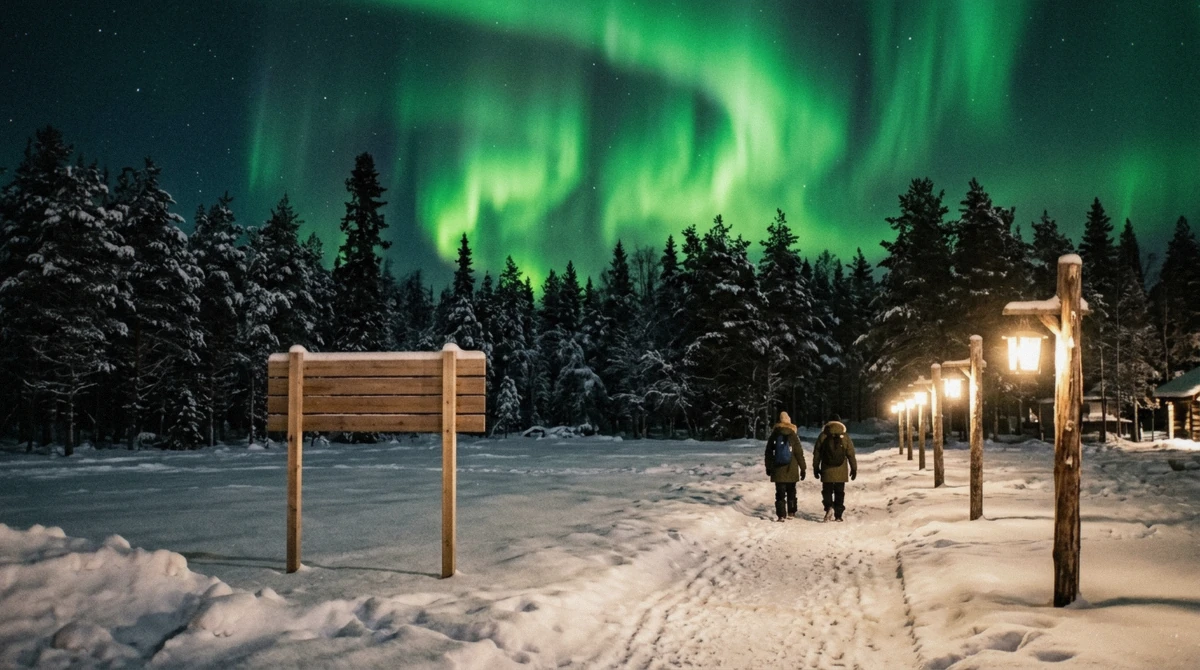
When a substorm breaks overhead, you will see it from the middle of the village, over the roof of the post office, with everyone else pointing their phones at it. Those nights happen, and the photographs from them are all over social media.
On an ordinary active night the aurora here appears as a pale arc low in the north. That arc is exactly what floodlights erase. The village is lit for photography and for moving crowds around in the dark, so the faint end of the range, which is most of the range, disappears before it reaches your eyes.
The village says as much itself. Its own visitor information states plainly that the northern lights depend on space weather and cloud, and that neither the village nor its companies can guarantee you will see them during your visit. That is the most useful sentence on any Rovaniemi tourism page.
What the odds look like in practice
The aurora season here runs from late August to early April. Within it, the statistical peaks sit around the equinoxes: September into early October, and March. Probability across the night peaks around 23:30, which is after most of the village has closed and the coach parties have gone.
So the realistic version of the plan looks like this. You spend the evening in the village, the sky does its best work an hour or two after the shops shut, and you are either still there in the cold with a way home, or you left at nine.
That mismatch, more than light pollution, is why so many visitors report seeing nothing at the village and then seeing plenty on a guided night out.
Wait at the Village or Drive Out With a Guide?
Stay at Santa Claus Village
- Free, and you are there anyway for the Arctic Circle crossing
- Cafes, shops and warmth within a minute's walk while you wait
- You are stuck with whatever sky sits over one spot
- Floodlighting kills the faint arc that makes up most nights
- The peak hour, around 23:30, falls after the last convenient bus
Go out with a guide
- The van moves to wherever the cloud breaks, up to 200 km away
- No lights, and a driver reading solar wind and cloud maps
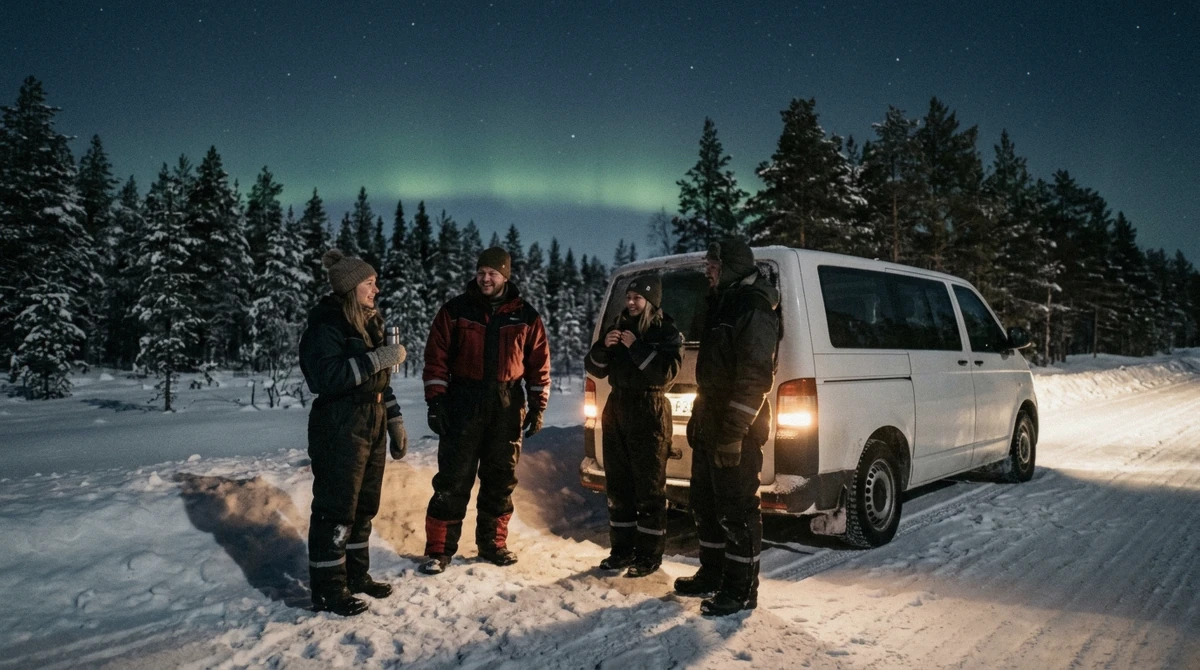
- Thermal overalls, hot drinks and photographs of you under the sky
- Costs from $83.17 to $227.87 per person
- You commit five to eight hours of the night, sometimes more
Verdict If the forecast is strong and you have several nights in Rovaniemi, an evening at the village costs nothing and might deliver. If you have one or two nights, or the sky over town is patchy, the van is the version that can chase a gap. Most visitors we hear from end up doing both, in that order.
Map: The Village, the Circle Line and the Darker Edges
Everything here sits within about 10 km of Rovaniemi city centre. The darker viewing spots are a short walk from the lit core, not a drive.
Getting There and Back After Dark
Bus 8 is the answer until it is not
Line 8 runs from Rovaniemi railway station through the city centre to Santa Claus Village and back. A single ticket bought from the driver costs €3.60 for adults and €1.80 for children, or slightly less through the Waltti app, which also sells a 24-hour ticket at €9 for adults.
The problem is the timetable rather than the price. The last useful evening departures leave well before the aurora hits its statistical peak around 23:30, so if you plan to wait for the sky you need a way home that is not the bus. Check the current winter timetable on the day; the seasonal schedules change and the winter one runs from mid-August to early June.
A taxi back into the centre covers 8 km and is the usual fallback. Agree the fare or make sure the meter is running before you set off, and be aware that on peak December evenings the queue at the village rank is long.
| How | Cost | Journey | Works at 23:30? |
|---|---|---|---|
| Bus 8 from the centre | €3.60 adult, €1.80 child from the driver | About 20 to 25 minutes | No, evening service ends earlier |
| Waltti app 24-hour ticket | €9 adult, €4.50 child | Same bus, unlimited rides that day | Only within service hours |
| Taxi | Metered, 8 km each way | 10 to 15 minutes | Yes, but expect a queue in December |
| Rental car | Winter rentals come on studded tyres as standard | 10 minutes, free parking at the village | Yes |
| Guided tour pickup | Included on some tickets, offered on the rest | Door to door | Yes, the tour runs past midnight anyway |
Where to stand once you are there
The darkest ground inside the village is its northern edge, past the last buildings and the car park, where the lamps fall behind you and the sky opens toward the forest. Just outside the village, the forest tracks running north are darker still and a few minutes further on foot.
Walk north. Past the last buildings the ground opens toward the forest, the lamps fall behind you, and your eyes get a fighting chance at the northern horizon. Give them twenty minutes; dark adaptation is slower than people expect, and looking at a phone resets it.
Do not bother trying to shoot the aurora against the lit archway or the Arctic Circle sign. Those photographs look good on a strong night and impossible on any other, because the exposure that captures a faint arc blows out the floodlights completely.
If you want the Arctic Circle marker in the frame, take that picture early in the evening and treat the aurora as a separate errand.
Glass Igloos and What They Really Buy You
A roof over the waiting, not better odds
Several glass-roofed places sit at the edges of the village, and more within a short drive. Arctic SnowHotel is about 30 km out, Apukka Resort a ten-minute drive from the village, and Lapland Deluxe roughly 50 km away.
What they solve is the endurance problem. You can watch the northern sky from a bed at two in the morning without standing at minus 15, and if nothing happens you have lost nothing but sleep. That is a real advantage over three hours in a car park.
What they do not solve is cloud. A glass roof under an overcast sky shows you an overcast sky, and the further-out properties trade the village's floodlights for genuine darkness, which is why the ones at 30 to 50 km read better in reviews than the ones at the village edge.
| Property | Distance from the village | What it changes |
|---|---|---|
| Glass rooms at the village edge | Walking distance | Warmth and a bed under the northern sky, but the same floodlit horizon |
| Apukka Resort | 10 minutes by car | Off the lit core, aurora alerts run by the property |
| Arctic SnowHotel | About 30 km | Genuine darkness, and a drive back into town in the morning |
| Lapland Deluxe | About 50 km | The darkest of the four, furthest from the airport and the shops |
Killing the hours until half past eleven
The village empties in the evening. Most of the shops, the post office and the reindeer and husky operators work daytime hours, and the coach groups leave before dinner.
If you are committed to waiting, plan it: eat at the village or bring food, keep a warm indoor spot in mind for the gaps, and dress for standing still rather than walking. Our layer-by-layer packing guide covers what that means when the air is at minus 15 and you are not moving.
The alternative plan, which more visitors end up taking, is to do the village in daylight for what it is good at, then let a driver handle the night. The aurora borealis tour Rovaniemi operators run all leave the city between seven and eight in the evening.
One more thing worth planning for: the walk. The gap between the lit village and the dark northern edge is short, but it is unlit, uneven under snow, and the temperature at ten in the evening in January averages close to minus 13.5 °C. Boots with grip matter more than anything else you carry, and a head torch with a red mode saves your night vision where a phone flashlight destroys it.
If the sky is closed and you want to salvage the evening, the reindeer and husky operators around the village run early sessions, and the DIY spots inside Rovaniemi itself are a ten-minute taxi away rather than an expedition.
Which Version of the Evening Suits You
If you have four or more nights in Rovaniemi
spend one clear evening at the village for free and keep a guided hunt in reserve for a cloudy one.
If you have one or two nights only
book the guided hunt and treat the village as a daytime stop. A fixed spot cannot chase a break in the cloud.
If you are travelling with young children
do the village in daylight and skip the 23:30 wait. A five to eight hour tour in the dark is a hard night for under-eights.
If you want the Arctic Circle marker in your aurora photograph
accept that it only works on a strong display, and shoot the marker separately earlier in the evening.
If you are staying in a glass room at the village edge
still book one hunt. The roof solves comfort, not cloud, and the darkest properties sit 30 to 50 km out.
Frequently Asked Questions
Can you see the northern lights from Santa Claus Village?
Yes, on a strong night. The village sits on the Arctic Circle at the right latitude, and a bright display is visible straight over the buildings. On an average active night the aurora appears as a faint arc low in the north, and the village's own floodlighting washes that out. The village states outright that it cannot guarantee sightings during your visit.
Where is the darkest spot at Santa Claus Village?
The northern edge, past the last buildings and the car park, where the ground opens toward the forest and the lamps sit behind you. Give your eyes twenty minutes to adapt and keep your phone screen off. It is a walk of a few minutes from the middle of the village, not a drive.
What time do the northern lights appear at Santa Claus Village?
The aurora is most active between roughly 21:00 and 02:00, with probability peaking around 23:30. That is the practical difficulty with waiting at the village: the peak window opens after the shops close and after the convenient evening buses back into Rovaniemi have gone.
How do you get back to Rovaniemi from Santa Claus Village late at night?
By taxi, by rental car, or on a tour that includes transport. Bus 8 covers the 8 km for €3.60 from the driver, but its evening service finishes before the best aurora hours. If you intend to wait past eleven, arrange the return before you go rather than after you are cold.
Which month is best for the northern lights at Santa Claus Village?
September into early October, and March. Those equinox windows carry the strongest statistical odds and much kinder temperatures than midwinter. December has the deepest darkness and the heaviest crowds, and its average night low sits near minus 10.6 °C. We break the whole season down in the month-by-month guide.
Is a glass igloo near Santa Claus Village worth it for the aurora?
It buys comfort rather than better odds. Watching from a bed at two in the morning beats standing in a car park, and the properties 30 to 50 km out, including Arctic SnowHotel at about 30 km, sit in genuine darkness. None of them changes the cloud cover, which is the variable that decides the night.
Do you need a tour if you are staying at Santa Claus Village?
Not on a clear, strong night. On the more common nights, a guided hunt can drive 20 to 100 km, and up to 200 km, to reach a break in the cloud that no fixed spot can reach. If your trip is short, that mobility is what you are paying for. Compare what the operators charge on the tour comparison.