 Aurora Borealis Tour Rovaniemi
Seeing the Northern Lights in Rovaniemi Without a Tour
Can you see the northern lights in Rovaniemi without booking anything? Yes. The aurora is free, the season runs from late August to early April, and four viewing spots sit within walking or short taxi distance of the city centre. What you cannot do on your own is move, which is the one thing the nine Rovaniemi aurora tours we compare are built around. A guided van drives to wherever the cloud breaks, sometimes 200 km away, and that single difference explains most of the gap between people who saw the lights on their trip and people who did not. Below: where to stand, what a self-drive night really costs against a ticket, and the nights when paying someone is the cheaper decision.
The Short Answer, and the Catch
Free, easy, and fixed in one place
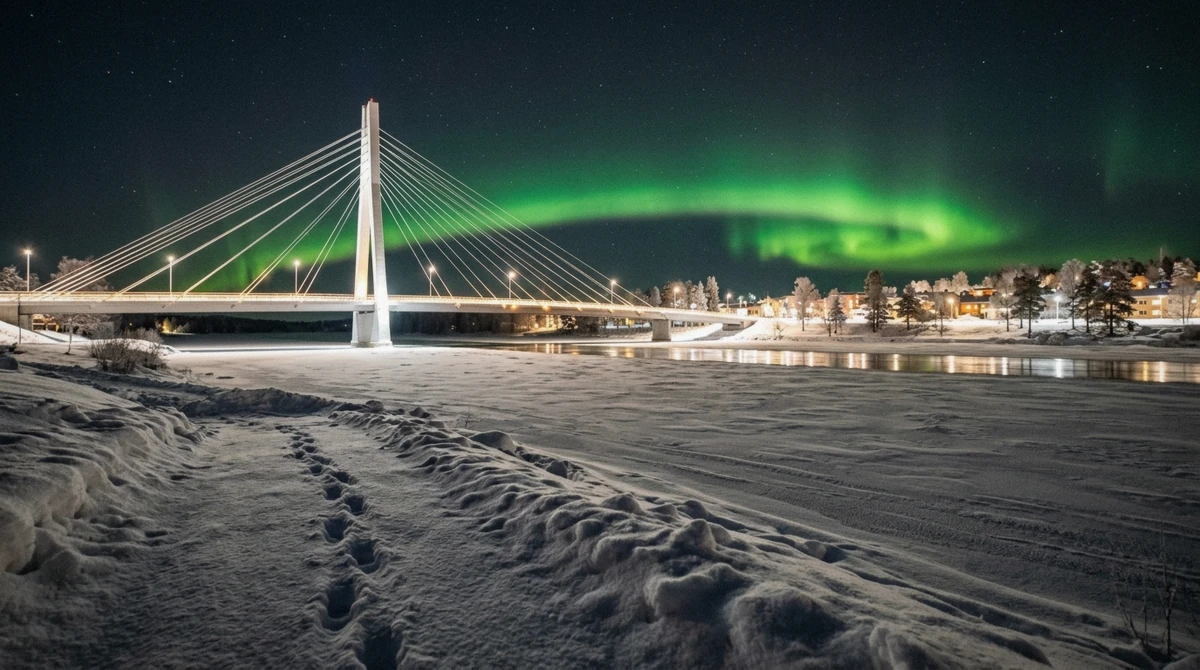
On a clear night with any geomagnetic activity at all, you can walk out of a hotel in the centre of Rovaniemi, cross to the river, and see an arc in the northern sky. People do it every winter. It costs nothing.
The catch is that Rovaniemi is a town of 65,000 with the lighting to match, and the aurora spends most of its time at the faint end of its range. Street lighting erases a pale arc long before it erases a substorm. So the DIY version works well on strong nights and poorly on ordinary ones, which is the wrong way round if you are here for four days in January.
The second catch is cloud. Lapland gets long overcast spells, and standing under one does not improve it. A guide with unlimited mileage treats cloud as a driving problem. Standing on a bridge, you have no answer to it at all.
How many nights it takes
Plan on three or four evenings of trying. That is the number that turns a coin flip into decent odds, and it matches what operators quote for their own reschedule guarantees.
A night of trying costs you an hour of standing outside, so the DIY approach scales well: you can do it every night of your stay for nothing, in whatever gaps your itinerary leaves.
What it does not do is rescue a trip where the whole week is overcast over Rovaniemi and clear 150 km west. That is the scenario guided hunts exist for, and the one where the ticket price stops looking expensive.
Doing It Yourself Against Going With a Guide
What we genuinely like
- Free, repeatable every night of your stay, no booking and no schedule
- Four workable spots within 4 km of the city centre, two of them walkable
- You keep your evening: no five to eight hour commitment, no 04:00 return
- You can step outside the moment an aurora alert fires, without a pickup time
- Good enough on strong nights, which are the nights the photographs come from
The honest downsides
- You cannot move to the clear sky, and cloud decides most nights in Lapland
- City lighting hides the faint arc that makes up the majority of displays
- No thermal overalls, so you need your own kit for standing still at minus 13.5 °C
- No one is reading solar wind graphs for you, so you wait blind
- No photographs of you under the lights, which is what most people actually want to take home
Who it's NOT for: Travellers with one or two nights in Rovaniemi, anyone without warm outer layers of their own, and anyone whose trip is built around getting the photograph rather than seeing the sky.
What a Do-It-Yourself Aurora Night Actually Costs
Free on foot, not free with a car
Walking to a viewpoint in Rovaniemi costs nothing. The moment you decide to chase clear sky, you are renting a car in a Lapland winter, and the arithmetic changes.
Every rental car in Lapland comes on studded or friction winter tyres during the season, which is standard rather than an extra. Winter tyres are compulsory in Finland from 1 November to 31 March, and outside those dates when conditions require them. You are not paying for tyres; you are paying for the car, the fuel and the risk of driving unfamiliar icy roads in the dark while tired.
For two people the sums land close together. For four, self-driving wins on money and loses on everything else.
| Approach | What you pay | How far you can chase | What you get back |
|---|---|---|---|
| Walk to a city viewpoint | Nothing | Zero. One sky, one spot | Whatever is overhead |
| Taxi to Ounasvaara or the village | Metered, a few kilometres each way | Under 10 km | Darker horizon, still one spot |
| Winter rental car, one night | Day rate plus fuel, studded tyres included | As far as you dare drive on ice at night | Full freedom, and all the driving |
| Guided hunt, cheapest ticket | $83.17 per person | 20 to 100 km as standard | Thermal overalls, hot drinks, photographs |
| Guided hunt, small group | $227.87 per person | Unlimited mileage, into Sweden if needed | Maximum eight guests, hotel pickup, eight hours |
Map: Free Viewing Spots You Can Reach Without a Car
All four sit inside or beside Rovaniemi. None needs a rental car, and two are a walk from most central hotels.
Driving Yourself in a Lapland Winter
What the rental desk will and will not tell you
Studded tyres come as standard on Lapland winter rentals, so that box is ticked before you arrive. Everything else is on you.
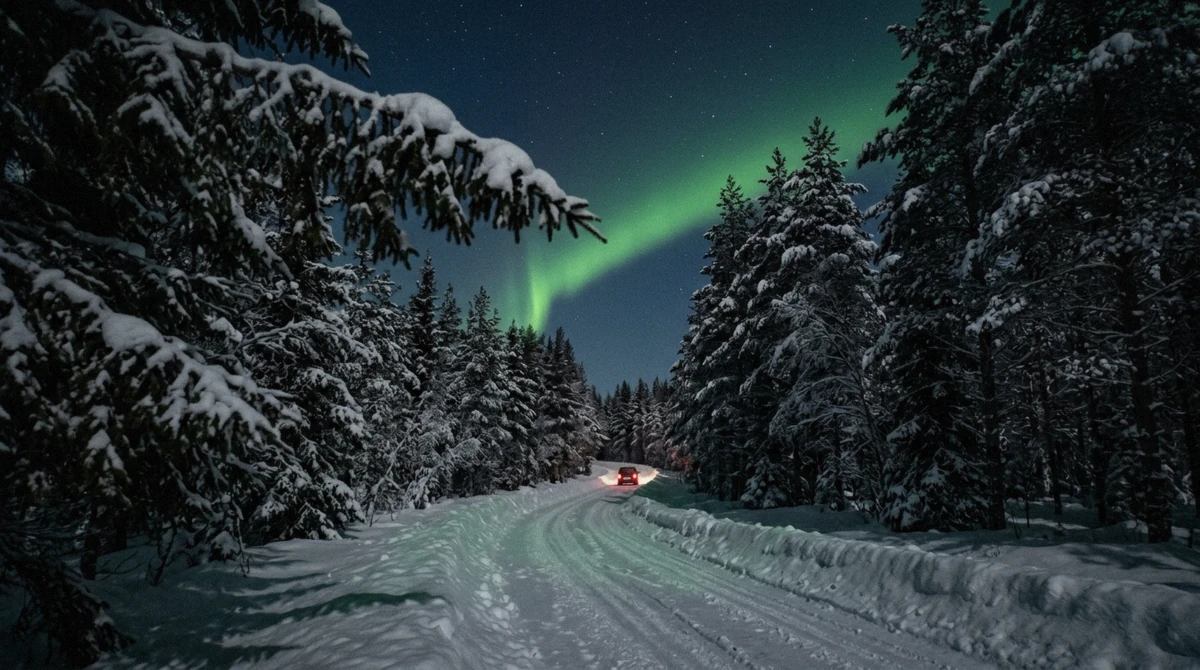
The roads are ploughed and generally excellent, with packed snow rather than slush for most of the winter. What catches visitors is the combination of darkness, glare from oncoming headlights on ice, and reindeer, which stand in the road and do not move. Hitting one is both a serious crash and a reportable incident.
Plough banks at the roadside look like firm ground and are not. Pulling off to look at the sky is how rental cars end up in the ditch, and a recovery in rural Lapland at midnight is not quick. Use a marked lay-by or a side road with a cleared verge, and leave your hazard lights on.
| Winter driving detail | What to know |
|---|---|
| Tyres | Studded or friction winter tyres are standard on Lapland rentals, and winter tyres are compulsory from 1 November to 31 March |
| Reindeer | They stand in the road and do not move. A collision is both a crash and a reportable incident |
| Plough banks | They look like firm verge and are not. Stop only in a cleared lay-by |
| Darkness | In December the sky is dark by four in the afternoon, so every aurora drive is a night drive |
| Fuel and range | Fill up before leaving town. Rural stations in Lapland close early |
Standing still at minus twenty
The cold on an aurora night is a standing-still cold, not a walking cold, and that is the distinction most first-time visitors miss. January night lows in Rovaniemi average about minus 13.5 °C under the Finnish Meteorological Institute's 1991 to 2020 normals, and clear aurora nights are colder than average because there is no cloud to hold the heat in.
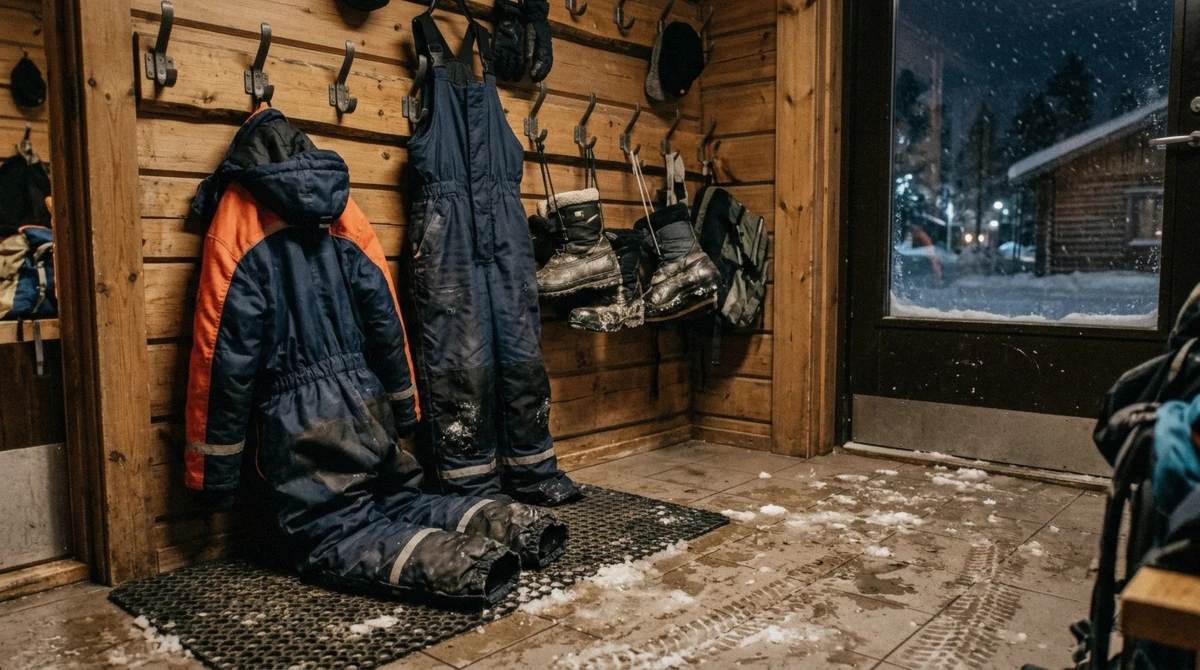
On a guided tour the operator hands you thermal overalls and boots that go over your own clothes. On your own, you need the whole system yourself, and a city coat is not it. We go through the layers, the gloves and what actually goes in your pockets in the what to wear guide.
One practical rule: bring a flask. Twenty minutes into a wait, warm hands do more for your patience than another layer does.
When the Guide Is the Cheaper Decision
Four situations where paying wins
The first is a short trip. With one or two nights, you cannot wait out weather, and a fixed spot gives you one roll of the dice per night.
The second is a stationary cloud front. When the whole region is covered, the only fix is distance, and guides have permission and fuel to cover 200 km or cross into Sweden. Guests describe three-hour drives toward Kiruna on exactly those nights.
The third is photography. Every tour we track includes a guide shooting with a DSLR and tripod, and files arrive by email in about 2 to 3 business days. Standing on a bridge with a phone, you will get an image of the sky and none of you in it.
The fourth is the group size question. A family of four paying four tickets should look hard at the numbers. Two people on a $83.17 ticket each are making an easy call.
- One or two nights in town: book, do not gamble
- Cloud over the whole region: only mileage helps
- You want photographs of yourselves under the aurora
- Nobody in the group wants to drive icy roads at 01:00
- You have no winter outer layers and do not want to buy them
The version most visitors end up doing
Book one hunt for the first clear-ish evening of the stay, then try for free on the other nights. The ticket carries free cancellation up to 24 hours ahead, so an early booking costs nothing if the week turns.
That combination gets you the mobility on one night and the free attempts on the rest, and it is what we would do with four evenings in Rovaniemi. The full comparison of the nine Rovaniemi aurora tours we compare sets out what each one includes, and the forecast guide covers which sources to check before you decide which night to use.
If the village is already on your list, what the sky does over Santa Claus Village is worth reading first, because the lighting there works against you.
Frequently Asked Questions
Can you see the northern lights in Rovaniemi without a tour?
Yes. On a clear night during the late August to early April season, an arc is visible from open spots in and around the city, and it costs nothing. The limitation is mobility: you are stuck with the sky over one place, and cloud stops more Lapland aurora nights than weak solar activity does.
Where can you see the northern lights in Rovaniemi for free?
Four spots work. The Jätkänkynttilä bridge gives an open northern view over the river, Ounasvaara hill sits 4 km out and above the streetlights, Kirkkolampi pond is quiet and close to the centre, and the northern edge of Santa Claus Village is 8 km out on bus 8 at €3.60 from the driver.
Do you need a car to see the aurora in Rovaniemi?
No, though a car lets you chase clear sky. Winter rentals in Lapland come on studded tyres as standard, and winter tyres are compulsory in Finland from 1 November to 31 March. The real costs are the day rate, the fuel and driving unfamiliar icy roads in the dark after midnight.
How many nights do you need to see the northern lights in Rovaniemi?
Three to four evenings of trying gives you decent odds. That is also what operators build their rescheduling around, which is why booking a tour for your first night and holding the rest of the week in reserve works better than saving it for the end of the trip.
Is it safe to stand outside at night in a Lapland winter?
Yes, with the right clothing and a plan for getting back. January night lows average about minus 13.5 °C, and clear aurora nights run colder still. The risk is not drama, it is standing still for an hour in a coat meant for walking between buildings. Grip on your boots matters as much as insulation.
How much cheaper is doing it yourself?
Free on foot, against $77.21 for the cheapest guided evening and $227.87 for the priciest hunt. With a rental car the gap narrows fast for two people and stays wide for four. What the ticket buys is mobility, thermal overalls and photographs of you under the sky, none of which the free version provides.
Can you see the northern lights from the centre of Rovaniemi?
On a strong display, yes, straight over the rooftops. On the faint arcs that make up most active nights, street lighting wins. Walking ten minutes to the river or taking a taxi up Ounasvaara changes the answer more than any equipment you could carry.